Frequently asked questions about clamping technology and cutting technology
clamping technology
Moulded cast iron clamps
1 top section
2 Profile rail
3 Lower part
4 Spindle with trapezoidal thread
5 Pressure plate
6 Handle
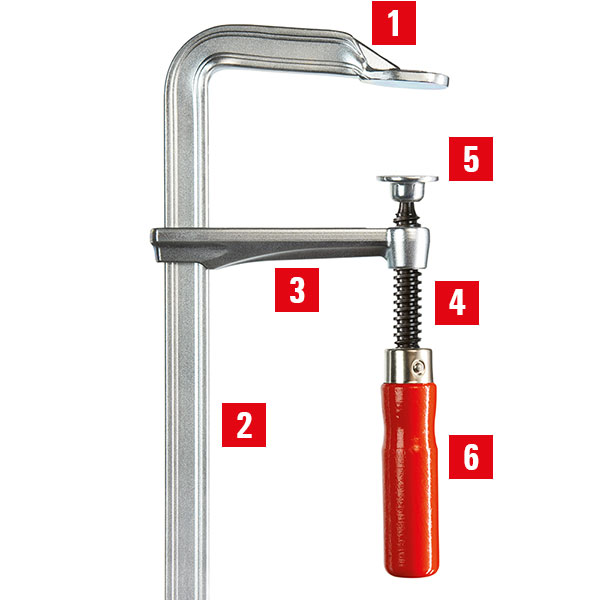
All-steel clamps
1 fixed clamp
2 Profile rail
3 Sliding bracket
4 Spindle with trapezoidal thread
5 Pressure plate
6 Handle
a Clamping length
The measurement is taken from the lower edge of the upper pressure plate to the upper edge of the lower pressure plate. The clamping width is the maximum workpiece length that can be clamped.
b Projection
Measured from the inside of the rail to the centre of the spindle.
x Rail cross-section
The width and thickness of the rail are measured. The larger the rail cross-section, the greater the possible clamping force.

The wooden handle
The wooden handle is the classic choice among handle types. BESSEY wooden handles are also special: they are ergonomically shaped and riveted without burrs, thus protecting the user from injury. Our wooden handles are made from FSC-certified wood. Furthermore, we do not use solvent-based varnishes on our wooden handles: the varnish used on BESSEY wooden handles is water-based and complies with DIN EN71/3.

The plastic handle
The modern two-component handle, specially developed for clamps from high-quality plastic, fits perfectly in the hand. Thanks to its symmetrical shape, the hand always grips in the right place, whether from above or below. The two plastic components (hard/soft material) are modelled on the twisting motion during clamping. This guarantees optimum grip and comfortable handling.

The folding handle
The folding handle offers all the advantages of the two-component plastic handle. In addition, it can be folded down by 90° and rotated by 360° without hitting the rail, for quick and comfortable working – even in hard-to-reach places. Here, the folding handle provides additional leverage when tightening.

The toggle handle
With its rounded ends, the toggle handle ensures good force transmission thanks to the additional leverage – even in confined spaces. Clamping tools with a toggle handle are often used in the metalworking industry: the toggle handle is resistant to welding spatter and can be tightened and released easily even when wearing oily or greasy gloves. The toggle handle also offers comfort to the user, as the ends are rounded for a comfortable grip.

The lever handle
Vices with a lever handle take a completely different approach to handle technology and the associated build-up of clamping force. The vice utilises the natural force of the lever. Instead of a thread, it features a ratchet mechanism with a toothed segment, similar to a ratchet. High clamping forces are thus achieved quickly with minimal effort. A release mechanism integrated into the handle also allows the clamp to be removed quickly. Thanks to their ease of use, lever clamps enable clamping five times faster than with conventional spindle clamps.
Lever clamps are often used when many clamps need to be set and released quickly to save time. The multi-stage ratchet mechanism ensures controlled, rapid and almost 100% vibration-proof clamping. In the original BESSEY GH lever clamps, the eccentric is made of sintered steel and is therefore particularly wear-resistant.

The pump handle
A high-quality two-component plastic handle with a pump lever behind the rail ensures secure access from both directions. The pushing motion created by pumping enables rapid clamping, whilst the release mechanism integrated into the handle allows the clamp to be released quickly. Furthermore, the pump handle can be operated with one hand – leaving the other hand free for other tools.
All-steel screw clamps are heat-treated and have an elastic clamping characteristic. They can bend slightly under load, thereby absorbing vibrations. This makes them ideal for metalworking or applications where dynamic forces are at play.
The key difference:
Malleable cast iron = rigid, precise, perfect for gluing wood
Solid steel = elastic, vibration-damping, ideal for metal in welding applications, for woodworking applications involving vibrations, for example when sawing or sanding
Here you will find the instructions in PDF format for two types of printing plates:
1. Flanged, permanently mounted printing plates are smooth (fig. left)
2. Replaceable printing plates have rib-like raised sections running around the cylindrical edge (fig. right)
Printing plate assembly (PDF download)To ensure that a screw clamp remains in good condition for a long time, proper care is essential.
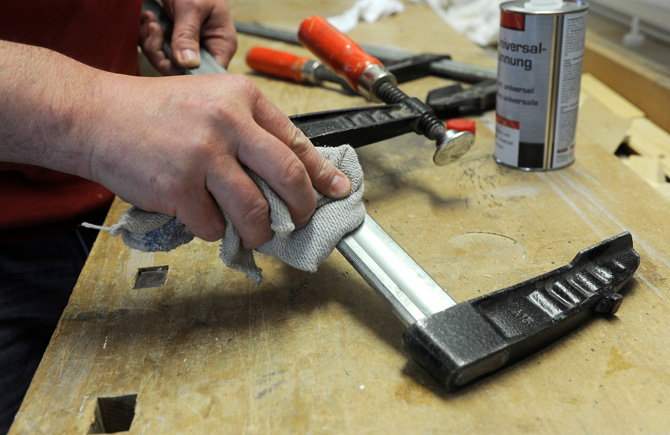
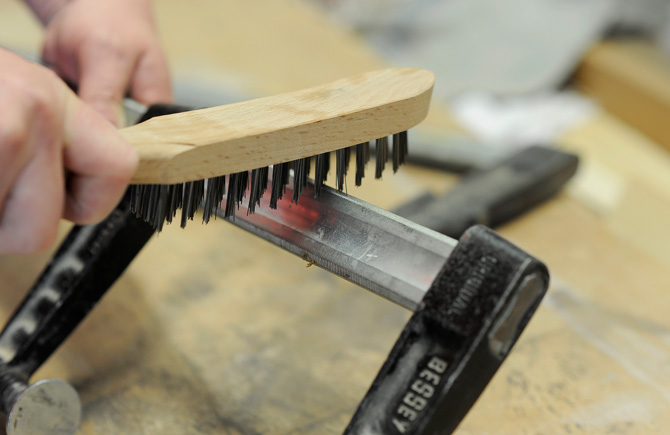
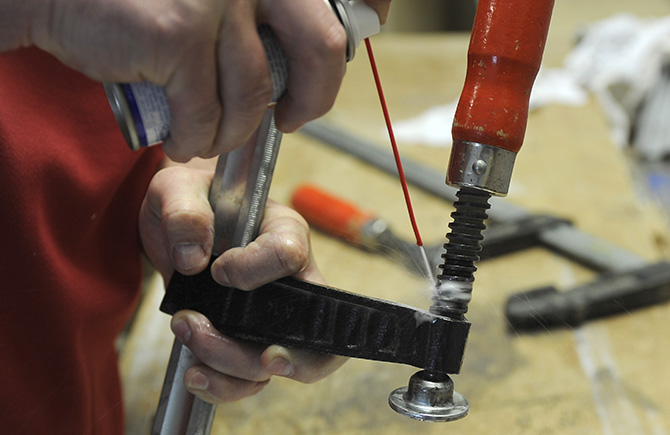
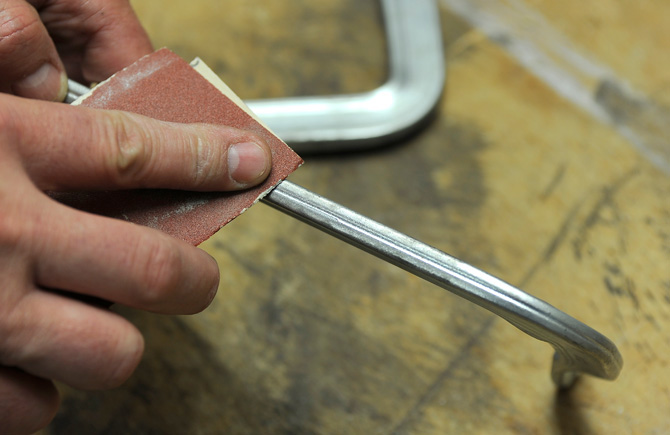
A screw clamp works by friction and wedging between the rail and the sliding bar. It is therefore important to keep the rail free of grease, oil or dried-on glue at all times. Waxes and silicone-based release agents on the rail are particularly problematic. Such residues must be removed as soon as possible using a solvent, wire brush or sandpaper. Both the spindle and the pressure plate joint should be lubricated regularly with a little oil. Spray oil is particularly suitable for this purpose. This ensures that the screw clamp remains smooth-running with optimum clamping force for a long time.
What to do if the screw clamp slips?
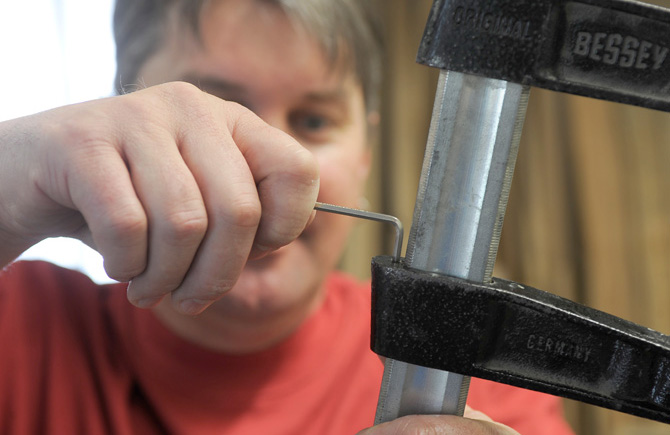
If a malleable cast iron screw clamp has a grub screw that prevents the sliding bar from slipping, this can be adjusted by a quarter turn if the grip weakens. With all-steel screw clamps, you should check for shiny patches on the rail, as these can cause the sliding bar to slip. If shiny patches are visible, they can be roughened on both sides using 100-grit emery cloth, thereby ensuring safe operation once again.
|
|
|
|
|
|
|
|
The varying lengths and spans of screw clamps can cause storage problems.
A clamp trolley offers a practical solution to this. This sturdy metal structure with castors allows the clamps to be hung up, sorted by size. Furthermore, a mobile clamp trolley enables more flexible and faster working , as all screw clamps can be kept within easy reach and neatly organised, ready for use directly at the work site.
Another storage option is a stationary clamp rack onto which the clamps can simply be slid.
| Original BESSEY Malleable cast iron screw clamp |
Second line from BESSEY |
Third line from BESSEY |
||||
|---|---|---|---|---|---|---|
| TG…-2K | TG… | TG…K | TPN…-2K | TPN… | TGRC… | |
| Opening a | 100–1,000 mm | 100–1,000 mm | 160–400 mm | 160–1,000 mm | 100–2,000 mm | 100–1,500 mm |
| Throat depth b | 50–175 mm | 50–175 mm | 80–175 mm | 80–175 mm | 50–175 mm | 50–175 mm |
| Clamping force up to | 6,000 N | 6,000 N | 6,000 N | 5,500 N | 5,500 N | 5,500 N |
| Pressure plates can be replaced with no need for tools (from 80 mm throat depth) |
✔ | ✔ | ✔ | – | – | – |
| Reinforced cast iron | ✔ | ✔ | ✔ | – | – | – |
| anti-slip system (from 80 mm throat depth) |
✔ | ✔ | ✔ | – | – | – |
| rail profile | Optimised profile | Optimised profile | Optimised profile | Standard profile | Standard profile | Basic profile |
| Intellectual property rights | ✔ | ✔ | ✔ | – | – | – |
| Original BESSEY Heavy dutymalleablecast iron screw clamp |
Second line from BESSEY |
Third line from BESSEY |
|||
|---|---|---|---|---|---|
| TGK…-2K | TGK… | TGK…K | TKPN… | TGKR… | |
| Opening a | 400–3,000 mm | 400–3,000 mm | 500–3,000 mm | 500–3,000 mm | 500–2,000 mm |
| Throat depth b | 120 mm | 120 mm | 120 mm | 120 mm | 120 mm |
| Clamping force up to | 7,000 N | 7,000 N | 7,000 N | 6,500 N | 6,500 N |
| Pressure plates can be replaced without the use of tools | ✔ | ✔ | ✔ | – | – |
| Reinforced cast iron | ✔ | ✔ | ✔ | – | – |
| anti-slip system | ✔ | ✔ | ✔ | – | – |
| rail profile | Optimised profile | Optimised profile | Optimised profile | Standard profile | Simple profile |
| Intellectual property rights | ✔ | ✔ | ✔ | – | – |
| Original BESSEY All-steel screw clamps |
Second line BESSEY classiX |
|||||
|---|---|---|---|---|---|---|
| GZ…-2K | GZ… | GZ…K | GZ…KG | GS… | GS…K | |
| Span a | 100–1,250 mm | 100–1,250 mm | 160–1,250 mm | 250–600 mm | 100–1,000 mm | 160–1,000 mm |
| Projection b | 60–140 mm | 60–140 mm | 80–140 mm | 120 mm | 50–140 mm | 80–140 mm |
| Clamping force up to | 6,000 N | 6,000 N | 6,000 N | 5,000 N | 5,000 N | 5,000 N |
| Tool-free interchangeable pressure plate (from 80 mm overhang) |
✔ | ✔ | ✔ | ✔ | – | – |
| Reinforced cast | ✔ | ✔ | ✔ | ✔ | – | – |
| Optimised rail profile | ✔ | ✔ | ✔ 20% more clamping force per spindle revolution | ✔ | – | – |
| Intellectual property rights | ✔ | ✔ | ✔ | ✔ | – | – |
| Original BESSEY Lever clamp |
Second line BESSEY classiX |
|
|---|---|---|
| GH… | GSH… | |
| Opening a | 100–1,250 mm | 100–1,000 mm |
| Throat depth b | 60–140 mm | 50–140 mm |
| Clamping force up to | 8,500 N | 7,500 N |
| Lever made of sintered steel | ✔ particularly wear-resistant, low friction due to higher surface hardness |
– |
| Optimised rail profile | ✔ greater reserves of force due to uniform clamping force build-up – particularly at full opening |
– |
| Intellectual property rights | ✔ | – |
cutting technology
In standard sheet metal shears , the blade and handle are traditionally forged as a single piece. The cutting force is determined by the ratio of the blade length to the handle length.
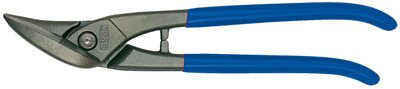
Hand-operated sheet metal shears with a lever ratio consist of a shear head and a handle. Both parts are mounted on hinges, resulting in an additional lever ratio.
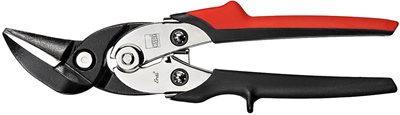
Ideal Shears
These shears truly live up to their name. Ideal shears are genuine ‘all-rounders’. You can use them to cut straight through sheet metal (through-cut) as well as to cut large and small contours or radii (shaped cut). It makes no difference whether you are cutting at the edge of the sheet (trimming cut) or in the middle of the panel. Of course, you can also use Ideal shears for simple notching work.
Shaped shears
Figurative shears are best suited if you wish to make fine, tight radius cuts at the edge of the sheet metal panel. Thanks to the delicate blade shape of these shears, you can effortlessly cut extremely tight shapes or curves.
Through-cut shears
Do you want to cut a sheet in the middle and/or at the edges? Then straight-cut shears are the right tool for you. With the long blades of these tools, you can quickly, with little effort and yet precisely cut to length and notch even large-format sheets.
Right-handed scissors are ground and designed in such a way that you can easily cut right-hand curves (i.e. a curve from left to right) with them. Curves from right to left are best cut with left-handed scissors.
It is often believed that right-handed scissors are for right-handers and left-handed scissors for left-handers. This is not true. On the contrary. When you, as a right-hander, cut a curve with right-handed scissors (see below, from left to right), you cut away from your wrist. With left-handed scissors (curve then from right to left), you cut towards your wrist. Which is significantly more ergonomic.
It is not just the quality of the scissors that affects the result. It also depends on using the tool correctly:
The sheet metal must be placed on the cutting jaw. Only then can an optimal cut be achieved due to the cutting radii. If it is not placed on the cutting jaw, it will warp. This results in increased effort and a shorter service life.
To cut, open the shears wide and push the sheet metal as far as possible into the jaws of the shears. The shears should not be closed completely whilst cutting: open the shears after about three-quarters of the cutting length and close them again. This is the only way to achieve a burr-free cut. If the shears are closed completely, small transverse cracks will form at the end of each cut.
It is also important to note that hand-operated sheet metal shears should only be used for cutting thin sheets of soft metals and steel . They are not suitable for cutting through round or square metal shapes, such as wire, as this would cause the blades to break.
|
|
|
|
|
|
|
|
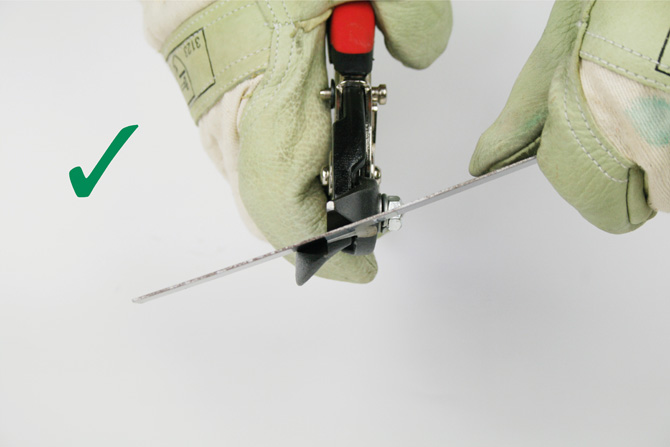
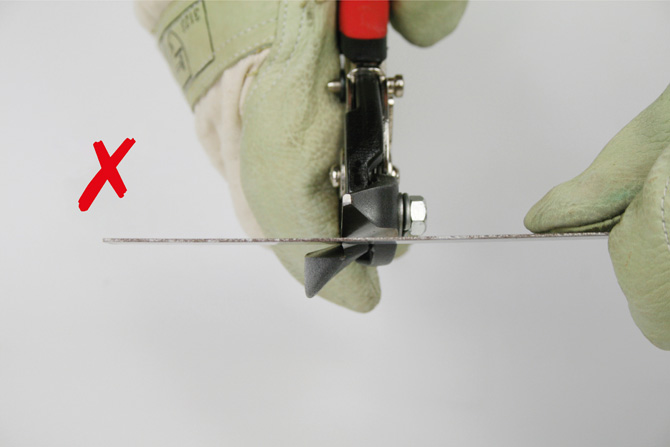
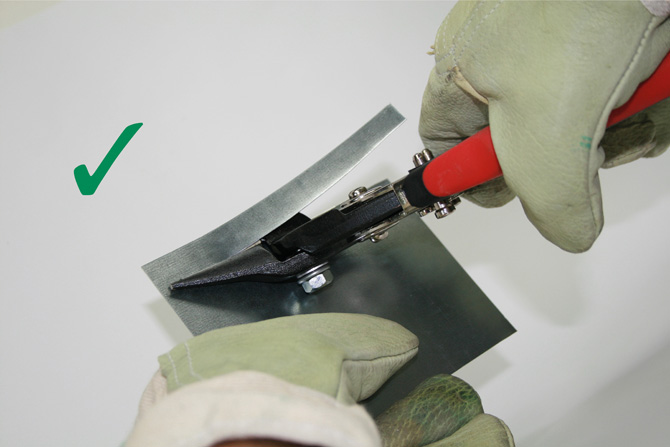
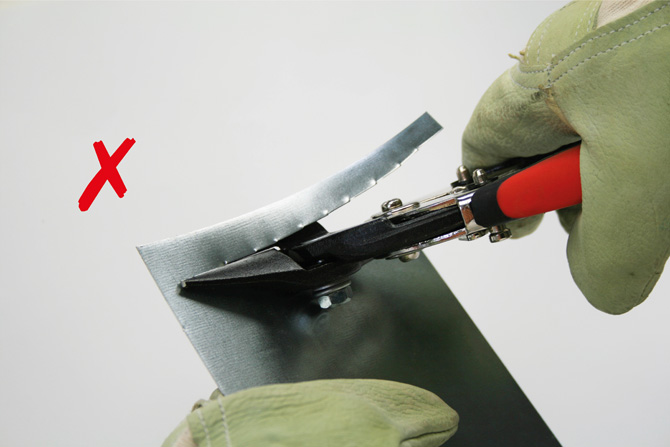
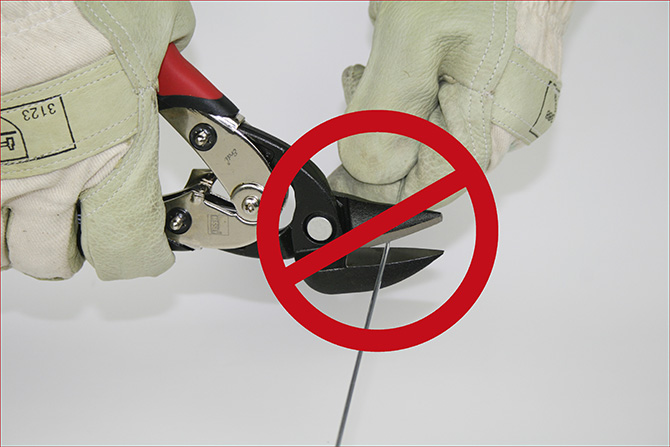
If you do not have enough strength to cut the sheet metal by hand, there could be two reasons for this: either the blades are simply blunt, or the sheet metal may be too thick. When using hand-operated sheet metal shears , it is important to ensure that you only cut sheets with a thickness of between 1.2 and 1.9 mm. However, this always depends on the type of sheet metal as well as the quality of the blades.

With the acquisition of the long-established Diener Werkzeugfabrik GmbH in 1979, BESSEY specifically expanded its product portfolio to include cutting technology. The Erdi brand, which was already renowned at the time for its high-quality sheet metal shears, was integrated into the company and continued as an independent product brand under the BESSEY umbrella. Today, the name BESSEY Erdi stands for a wide range of cutting tools that combine BESSEY’s innovative strength and quality standards with the long-standing expertise and tradition of Erdi shears. Users thus benefit from a clear quality promise and a consistent brand identity within the BESSEY range.